Why alpine posters are tall
The great Swiss and Austrian railway posters of the 1920s and 30s were usually portrait, and not by accident. A tall format lets you stack a foreground, a village, a mountain and a sky without cramming them side by side — the eye climbs the poster the way a funicular climbs the slope.
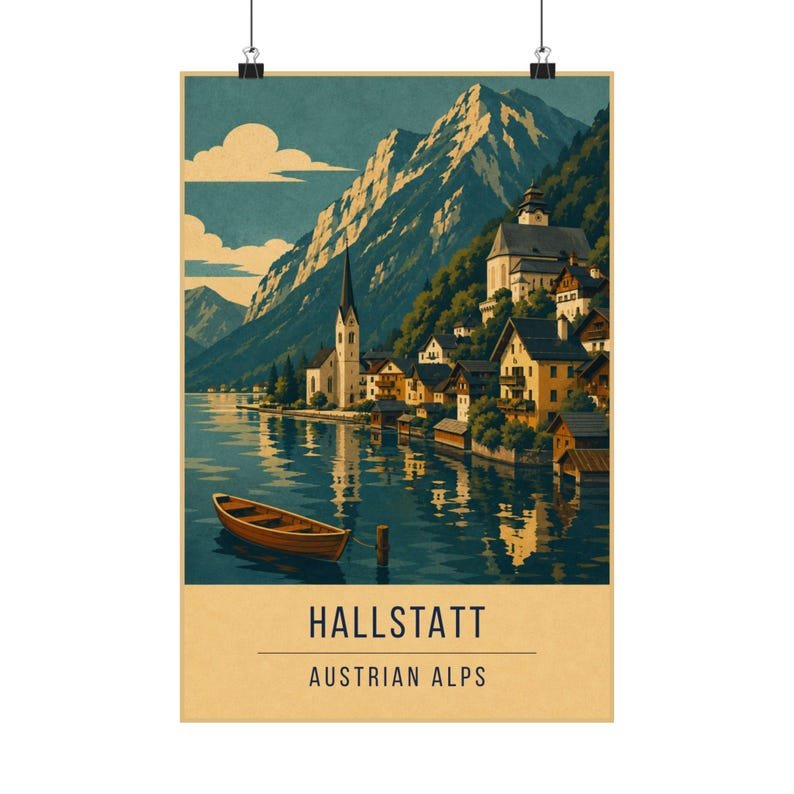
Hallstatt asks for exactly that treatment. The lake occupies the bottom, the village sits as a bright band across the middle, and the rock face fills everything above it.
Cold light, warm windows
Alpine light is cool and flat, which is why the navy and teal carry most of this print. The danger is that it becomes cold and lifeless, so the warmth is concentrated in a narrow band: the terracotta roofs and the mustard glow in the windows of the village.
That contrast — a small warm strip inside a large cool field — is what gives the print its pull. It is the same reason a lit window in winter is more interesting than a lit window in summer.
Where it works on a wall
This is the coolest and quietest print in the collection, and it suits a study, a stairwell or a bedroom — somewhere you pass slowly rather than sit and stare.
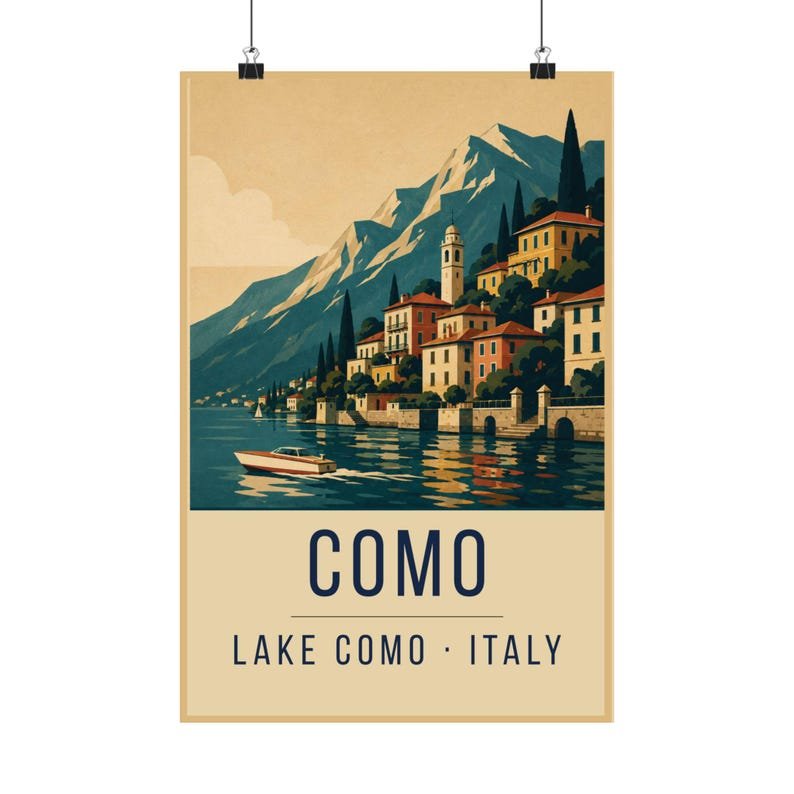
Pair it with Lake Tahoe for two mountain lakes on different continents, or against Lake Como for the warm-versus-cool contrast.